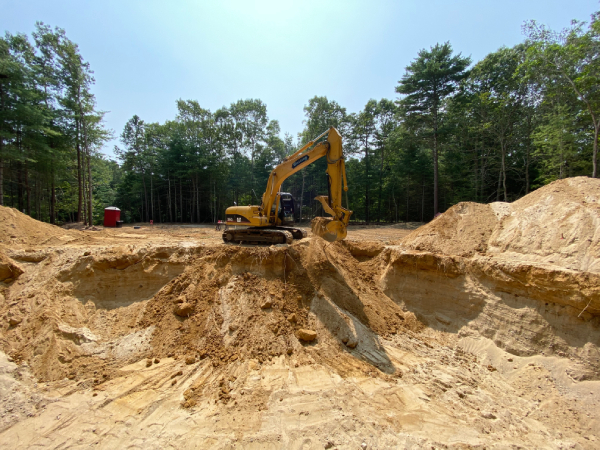
Quick answer: Site work and land development is the earthwork that turns a raw or existing lot into a build-ready property — land clearing, rough grading, foundation excavation, utility trenching, drainage and septic installation, driveway sub-base, and finish grading. Across Cape Cod (Barnstable County) and Plymouth County, that process is shaped by sandy soil and high water tables near the coast, ledge and glacial till further inland, and wetlands or Conservation Commission review near ponds and the shoreline. A basic residential lot prep typically runs $10,000–$25,000, a full site development package from clearing to finish grade runs $25,000–$60,000+, and commercial site development generally starts around $75,000. Most residential lots are construction-ready in 1 to 4 weeks once permitting is complete.
Below, we break down exactly what site work and land development involves, why Cape Cod and Plymouth County properties come with unique challenges, and what to budget for before you break ground.
What Does "Site Work" Actually Include?
"Site work" and "land development" cover every phase of earthwork that happens before, during, and immediately after vertical construction. At Williams Co. Excavation, a typical site development package includes:
- Land clearing & demolition: Removing trees, stumps, brush, and any existing structures to create a clean building envelope.
- Rough grading & earthwork: Cutting and filling soil to balance the site and establish the correct elevations for the building pad, driveway, and yard.
- Foundation excavation: Digging basements, footings, or crawl spaces to the exact depth and dimensions specified in the engineered plans.
- Utility trenching: Digging trenches for water, sewer, electric, gas, and telecommunications lines, coordinated with local utility providers and Dig Safe.
- Drainage & septic installation: Installing stormwater drainage systems and Title 5 or I/A septic systems where municipal sewer isn't available.
- Driveway & access road sub-base: Excavating topsoil and compacting gravel or processed aggregate to create a stable base for asphalt, concrete, or crushed stone.
- Finish grading & hydroseeding: Spreading topsoil, sculpting final landscape contours, and hydroseeding to establish a new lawn once construction wraps up.
Why Land Development Looks Different on Cape Cod & in Plymouth County
An excavation and site development contractor working from Plymouth down to the Cape (Barnstable County) deals with soil, water, and regulatory conditions that don't show up the same way near Boston. Here's what makes this region distinct:
Sandy Soil & High Water Tables on the Cape
Cape Cod sits on a glacial outwash plain, so soil is largely sand and gravel — great for drainage, but combined with a narrow peninsula and shallow groundwater, it often limits how deep a foundation or septic system can be built. Site plans frequently need raised foundations, engineered fill, or extra drainage capacity to work around a high seasonal water table.
Ledge & Glacial Till Inland in Plymouth County
Move inland to towns like Plymouth, Carver, and Kingston, and the terrain shifts to glacial till with buried boulders and occasional ledge outcrops. Hitting ledge mid-excavation can require hydraulic breaking equipment, which adds real time and cost that a standard quote won't always anticipate until digging begins.
Wetlands & Conservation Commission Review
Much of Plymouth County and virtually all of Cape Cod sits near wetlands, marshes, kettle ponds, or coastal resource areas regulated under the Massachusetts Wetlands Protection Act. Site development within a Conservation Commission's jurisdiction needs their sign-off in addition to a standard building permit — a review cycle that can add several weeks, so it pays to start the permitting process early.
Nitrogen-Sensitive Septic Requirements on New Construction
New homes on Cape Cod that aren't on municipal sewer often fall under the Cape Cod Area Wide Water Quality Management Plan, which requires or incentivizes nitrogen-reducing Innovative/Alternative (I/A) septic systems in many towns. These systems have a larger footprint than a conventional system, which needs to be factored into the site plan and grading design from day one.
Small, Older, or Oddly-Shaped Lots in Village Centers
Many Cape Cod village neighborhoods and older Plymouth County subdivisions predate modern lot-size and setback requirements. Fitting a code-compliant foundation, septic system, and driveway on a small or irregular lot often requires creative grading and a more involved excavation plan than a standard suburban build.
Dig Safe & Utility Coordination
Before any digging starts, Massachusetts law requires a Dig Safe request to mark existing underground utilities. On older Cape Cod and Plymouth County properties, utility records aren't always accurate, so an experienced site contractor will proceed carefully around marked lines and coordinate directly with utility providers when new services need to be run.
The Site Development Process, Step by Step
- Site plan & permitting. A surveyor stakes the property lines and building footprint, and the site plan goes to the local building department and, if applicable, the Conservation Commission.
- Land clearing. Trees, stumps, brush, and any existing structures are removed to create a clean building envelope.
- Rough grading & earthwork. The contractor cuts and fills soil to establish the building pad elevation and overall site contours.
- Foundation excavation. The foundation hole is dug to the exact depth and dimensions in the engineered plans, ready for concrete work.
- Utility trenching. Trenches are dug for water, sewer, electric, and gas lines, coordinated with Dig Safe and local utility providers.
- Septic & drainage installation. The septic system and stormwater drainage solutions are installed before backfilling.
- Driveway & access road base. Topsoil is stripped and gravel or aggregate is compacted to create a stable sub-base.
- Finish grading & hydroseeding. Once construction is complete, the final landscape contours are shaped, topsoil is spread, and the lawn is hydroseeded.
Total timeline depends heavily on lot condition and permitting complexity — a flat, clear lot with straightforward permitting can be ready for a foundation in a matter of days, while a complex project with extensive clearing, ledge, or wetlands review can take several weeks to a couple of months before vertical construction starts.
Residential vs. Commercial Site Work: What Changes
The fundamentals of site development are the same whether you're building a single-family home or a commercial property, but scale and regulatory requirements shift significantly:
- Stormwater management plans: Commercial projects typically require an engineered stormwater management plan and permit, whereas residential lots often manage runoff with simpler grading and drainage.
- Larger drainage & detention systems: Commercial sites frequently need retention or detention basins, larger catch basin networks, and dry wells sized to handle impervious surface area like parking lots.
- ADA-compliant grading: Commercial parking areas, walkways, and building entrances must meet ADA slope and accessibility requirements, which adds precision to the grading plan.
- Longer permitting timelines: Commercial site plans generally go through planning board review in addition to a building permit, which can extend the pre-construction timeline compared to a residential project.
Whether it's a residential build or a commercial job, Williams Co. Excavation acts as a single point of contact for the entire earthwork scope, which keeps multiple subcontractors from working out of sync and causing costly delays.
What Does Site Work & Land Development Cost on Cape Cod & in Plymouth County?
| Scope of Work | Typical Cost Range |
|---|---|
| Basic residential lot preparation | $10,000 – $25,000 |
| Full site development (clearing through finish grade) | $25,000 – $60,000+ |
| Commercial site development | $75,000+ |
| Additional cost if ledge or wetlands mitigation is required | +$5,000 – $20,000+ |
Costs vary based on lot condition, soil type, permitting complexity, and site access. A heavily wooded, sloped lot with ledge will cost meaningfully more to prepare than a flat, cleared parcel, and projects requiring I/A septic systems, wetlands mitigation, or extensive utility trenching will land at the higher end of the range or above it. Get a detailed, fixed-scope estimate after a site evaluation of your specific property and plans — this is the best way to avoid the cost overruns that catch homeowners and builders off guard.
Frequently Asked Questions
What is included in site work for a new home or commercial building?
Site work covers all the earthwork required before a structure can be built. It typically includes land clearing and stump removal, rough grading to establish the property's contours, foundation excavation, utility trenching for water, sewer, and electric, drainage and septic installation, driveway sub-base preparation, and finish grading and hydroseeding once construction is complete.
How much does site work and land development cost on Cape Cod or in Plymouth County?
Basic residential lot preparation typically runs $10,000 to $25,000, while a full site development package from clearing through finish grade runs $25,000 to $60,000 or more. Commercial site development is generally $75,000 and up. Costs depend heavily on lot condition — wooded, sloped, or ledge-heavy lots cost significantly more than flat, cleared parcels.
Do I need a permit for land clearing, grading, or site development in Massachusetts?
Yes. Most site development requires a building permit from your local building department, and properties near wetlands, ponds, or coastal resource areas also need Conservation Commission approval under the Massachusetts Wetlands Protection Act. Commercial projects often require an additional stormwater management permit.
How does soil type affect site development costs on Cape Cod?
Cape Cod's sandy, glacial outwash soil drains well but often sits over a high water table, which can require raised foundations, imported fill, or engineered drainage. Inland in Plymouth County, glacial till with buried boulders and ledge outcrops can require hydraulic breaking equipment, adding meaningful cost and time to excavation.
What is the difference between rough grading and finish grading?
Rough grading happens early in the project and shapes the site's major elevations, cutting and filling soil to create a level building pad and proper drainage slopes before foundation work begins. Finish grading happens at the end of the project, fine-tuning the surface, spreading topsoil, and preparing the yard for landscaping or hydroseeding.
Can a wooded or undeveloped lot be prepared for construction?
Yes. Undeveloped, wooded lots are common across Cape Cod and Plymouth County. The process starts with land clearing and stump removal, followed by rough grading to shape the site according to the approved site plan, then foundation excavation and utility work proceed as they would on a cleared lot.
How long does site development take before construction can start?
A flat, clear lot with straightforward permitting can be ready for foundation work in a few days to a week. A complex project involving extensive clearing, ledge removal, wetlands review, or complicated utility trenching can take several weeks to a couple of months, with permitting often the longest phase.
Site Work & Land Development Service Areas
Williams Co. Excavation provides site work, land development, and earthwork services throughout Plymouth County and Cape Cod (Barnstable County), including:
- Plymouth, MA
- Kingston, MA
- Duxbury, MA
- Carver, MA
- Barnstable, MA
- Falmouth, MA
- Yarmouth, MA
- Mashpee, MA
- Sandwich, MA
- Bourne, MA
Don't see your town listed? View our full service area or contact us to confirm coverage.
Williams Co. Excavation has completed residential and commercial site development throughout Plymouth County and Cape Cod, including Sandwich, Falmouth, and Bourne. Planning new construction? Contact us for a site evaluation and fixed-scope quote.