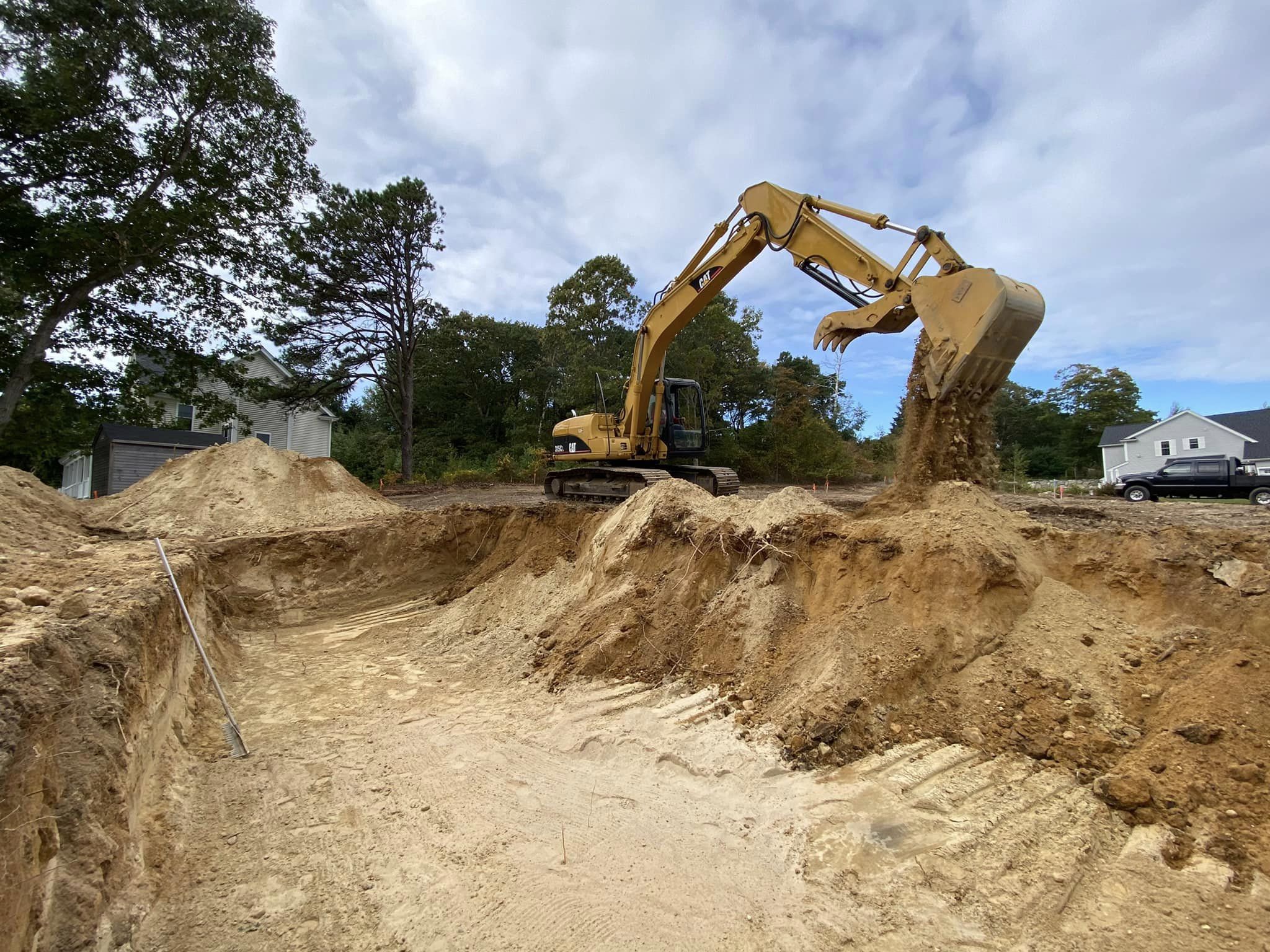
Quick answer: An ADU (accessory dwelling unit) is a secondary, self-contained living space (detached, attached, or converted from existing space like a garage) built on the same lot as a single-family home. Massachusetts' 2024 Affordable Homes Act made it easier to build one: as of February 2025, most cities and towns must allow at least one ADU up to 900 square feet by right, without a special permit, in any zoning district that allows single-family housing. But zoning approval is only half the equation: your septic system (or sewer connection) still needs adequate capacity for the added bedroom, your foundation and drainage plan need to account for Cape Cod's sandy soil and high water table or Plymouth County's ledge and glacial till, and your site still needs to meet setback and lot coverage requirements. Williams Co. Excavation handles the full ADU site package, including clearing and prep, foundation excavation, grading, and septic connections or upgrades, for a fixed-scope quote. Typical ADU site work runs $10,000+ before any septic upgrade, and most straightforward projects are ready for foundation work in 1 to 4 weeks once permitting is complete.
Below, we break down what actually changed under the new Massachusetts ADU law, why ADU site work looks different on Cape Cod and in Plymouth County, and what to budget for before you start planning.
What Is an ADU, and What Changed Under Massachusetts' 2024 Law?
An accessory dwelling unit (ADU) is a smaller, independent home, with its own kitchen, bathroom, and sleeping area, located on the same lot as a primary single-family home. ADUs come in a few common forms: a detached backyard cottage, an addition attached to the main house, a basement or above-garage conversion, or a garage rebuilt into livable space.
Historically, many Massachusetts towns required a special permit, a public hearing, and sometimes an owner-occupancy restriction before an ADU could be built, a process that could take months and wasn't guaranteed to succeed. That changed with the Affordable Homes Act, signed in August 2024. Effective February 2, 2025, the law requires every city and town to allow at least one ADU up to 900 square feet "by right" (meaning no special permit or discretionary hearing) in any zoning district that allows single-family homes, as long as the ADU meets the same dimensional requirements (setbacks, height, lot coverage) as other structures on the property. The law also bars towns from imposing an owner-occupancy requirement and caps how many off-street parking spaces a town can require for an ADU at one.
What the law does not override is site capacity. A by-right ADU still has to fit within your lot's setbacks and coverage limits, and, critically for most of Cape Cod and Plymouth County, where municipal sewer isn't available, your septic system still has to have (or be upgraded to have) enough design capacity for the additional bedroom under Title 5. Some towns also still require site plan review for detached or larger ADUs, so it's worth confirming the specifics for your address with your local building department before finalizing a design.
Why ADU Site Work Looks Different on Cape Cod & in Plymouth County
Once zoning is cleared, the earthwork and utility side of an ADU project is where most of the real planning happens. An excavation contractor working from Plymouth down to the Cape (Barnstable County) has to account for conditions that don't show up the same way near Boston. Here's what makes ADU site work distinct in this region:
Septic Capacity: The Biggest Constraint on Septic-Served Lots
Most homes on Cape Cod and across much of Plymouth County rely on a private septic system rather than municipal sewer. Title 5 (310 CMR 15.000) sizes a septic system's design flow based on the number of bedrooms in every dwelling it serves, so adding an ADU bedroom, even a small one, can push an existing system past its rated capacity. Before committing to a design, a septic system evaluation will confirm whether your current system has room to spare or needs to be upgraded, expanded, or replaced. In nitrogen-sensitive Cape Cod watersheds, that may mean the replacement system has to be an Innovative/Alternative (I/A) system, which has a larger footprint and a meaningfully different excavation scope than a standard system.
Sandy Soil, High Water Tables & ADU Foundation Choices
Cape Cod's glacial outwash soil is mostly sand and gravel, which drains well but sits over a shallow seasonal water table across much of the peninsula. That combination often limits how deep an ADU foundation can go, which is why slab-on-grade and frost-wall foundations are more common for detached ADUs here than full basements. Garage conversions and additions built above an existing foundation are also popular alternatives that reduce excavation scope and sidestep water-table issues entirely.
Lot Size, Setbacks & Septic Separation on Small Lots
Many Cape Cod village-center neighborhoods and older Plymouth County subdivisions sit on lots platted well before modern zoning. Fitting a code-compliant ADU footprint, its required setbacks, and Title 5's separation distances between the septic system, the well, and both dwellings onto a small or irregularly shaped lot often takes creative site planning, and sometimes rules out a detached ADU in favor of an attached addition or conversion.
Drainage & Grading for a Second Dwelling
Adding a second structure, a new roofline, and often a new driveway or parking pad increases the impervious surface on a lot, which changes how stormwater moves across the property. A proper ADU site plan regrades around the new structure to keep runoff away from both buildings and the septic system's leach field. Before any digging starts, Massachusetts law also requires a Dig Safe request to mark existing underground utilities, an important step on older properties where utility records aren't always accurate, especially when a new water, electric, or septic line needs to be run to a detached unit.
Wetlands & Conservation Commission Review Near the Coast
Much of Plymouth County and virtually all of Cape Cod sits near wetlands, kettle ponds, marshes, or coastal resource areas regulated under the Massachusetts Wetlands Protection Act. An ADU project within a Conservation Commission's jurisdiction needs their sign-off in addition to a standard building permit, a review cycle that can add several weeks, so it's worth starting the permitting process early.
Ledge & Glacial Till Inland in Plymouth County
Move inland to towns like Plymouth, Carver, and Kingston, and the soil shifts to glacial till with buried boulders and occasional ledge outcrops. Hitting ledge mid-excavation for an ADU foundation or utility trench can require hydraulic breaking equipment, adding real time and cost that a standard quote won't always anticipate until digging begins.
The ADU Site Work Process, Step by Step
- Zoning & by-right review. Confirm your ADU's size, placement, and design meet your town's by-right dimensional requirements, or whether site plan review applies.
- Septic capacity evaluation. A septic professional assesses whether your existing system can support the added bedroom, or whether an upgrade is needed.
- Survey & staking. A surveyor marks the property lines and the ADU's footprint relative to setbacks and the existing septic system.
- Land clearing & grading, if needed. Trees, brush, or existing structures are cleared from the building envelope and the site is rough-graded.
- Foundation excavation. The contractor excavates the foundation hole to the depth and dimensions specified in the engineered plans.
- Utility trenching. Trenches are dug for water, electric, and septic or sewer connections, coordinated with Dig Safe and local utility providers.
- Septic upgrade or connection. The septic system is upgraded, expanded, or connected to serve the additional bedroom.
- Driveway or parking pad. A gravel or paved sub-base is prepared if the ADU requires separate access or parking.
- Backfill & finish grading. The site is backfilled, regraded around both structures, and finished to direct water away from the buildings and septic system.
A straightforward ADU on a flat, cleared lot with an existing septic system that has spare capacity can be ready for foundation work in about 1 to 4 weeks once permitting is complete. Projects that require a septic upgrade, wetlands review, or ledge removal typically take several weeks to a couple of months longer.
What Does ADU Site Work & Septic Prep Cost on Cape Cod & in Plymouth County?
| Scope of Work | Typical Cost Range |
|---|---|
| ADU foundation excavation (slab or frost-wall, up to 900 sq ft) | $5,000+ |
| Full ADU site package (clearing, foundation, utilities, grading) | $20,000+ |
| Septic upgrade or expansion for added bedroom capacity | $10,000+ |
| New or expanded I/A septic system sized for house + ADU | $30,000+ |
| Additional cost if ledge, wetlands mitigation, or a mound system is required | +$5,000 – $15,000+ |
Costs vary based on ADU type (detached vs. attached vs. conversion), lot condition, soil type, and whether your existing septic system (often the biggest variable) has spare capacity or needs to be upgraded. A detached ADU on a wooded, ledge-prone, or septic-constrained lot will land at the higher end of these ranges or above them. Get a fixed-scope quote after a site evaluation that includes a septic capacity check; that single step prevents the most common cost surprises on ADU projects.
Frequently Asked Questions
Do I need a permit to build an ADU in Massachusetts?
Yes. Even though Massachusetts' 2024 Affordable Homes Act allows many ADUs to be approved "by right" without a special permit, you still need a standard building permit from your local building department, plus confirmation that your septic system or sewer connection has adequate capacity for the additional bedroom.
Can I build an ADU without a special permit under the new Massachusetts law?
As of February 2, 2025, cities and towns must allow one ADU up to 900 square feet by right in any zoning district that allows single-family homes, provided it meets dimensional requirements like setbacks and height, and the property's septic system or sewer connection has adequate capacity. Some towns still require site plan review for larger or detached ADUs, so check with your local building department to confirm requirements for your address.
Does my septic system need to be upgraded to add an ADU?
Often, yes. Title 5 sizes septic systems based on the number of bedrooms, so adding an ADU bedroom may exceed your existing system's design flow. A septic system evaluation will confirm whether your current system has spare capacity or needs to be upgraded, expanded, or replaced to legally support the additional bedroom.
What type of foundation is best for an ADU on Cape Cod?
It depends on the site. A slab-on-grade or frost-wall foundation is common for detached ADUs on Cape Cod's sandy soil, especially where a high water table limits basement depth. Garage conversions and additions above an existing foundation are also common alternatives that reduce excavation scope.
Can I add an ADU on a small or older lot in a Cape Cod village center?
Yes, though small and irregularly shaped lots often require more careful site planning to meet setback, lot coverage, and septic separation requirements simultaneously. An experienced excavation contractor can help evaluate whether a detached ADU, garage conversion, or addition fits your specific lot.
How much does site work cost for building an ADU?
Site work for an ADU foundation typically runs $5,000 to $18,000, while a full site package covering clearing, foundation, utility trenching, and grading runs $20,000 to $45,000 or more. If your septic system needs to be upgraded or replaced to support the added bedroom, that adds $10,000 to $50,000+ depending on system type.
Do ADUs need their own utility connections or driveway?
It depends on the ADU type. Many detached ADUs tie into the main house's water, electric, and septic system, while some require separate utility runs or metering depending on the design and local requirements. A separate driveway or parking space is common for detached ADUs, though the Affordable Homes Act limits how many off-street parking spaces a town can require.
ADU Site Work Service Areas
Williams Co. Excavation provides ADU site work, foundation, and septic services throughout Plymouth County and Cape Cod (Barnstable County), including:
- Plymouth, MA
- Kingston, MA
- Duxbury, MA
- Carver, MA
- Barnstable, MA
- Falmouth, MA
- Yarmouth, MA
- Mashpee, MA
- Sandwich, MA
- Bourne, MA
Don't see your town listed? View our full service area or contact us to confirm coverage.
Williams Co. Excavation offers full ADU site packages across Plymouth County and Cape Cod, including clearing and prep, foundation excavation, grading, and septic connections or upgrades. Planning an ADU? Contact us for a site evaluation and fixed-scope quote.